Homeworld: Unboundactivefully playablework in progressSideQuest →Releases →
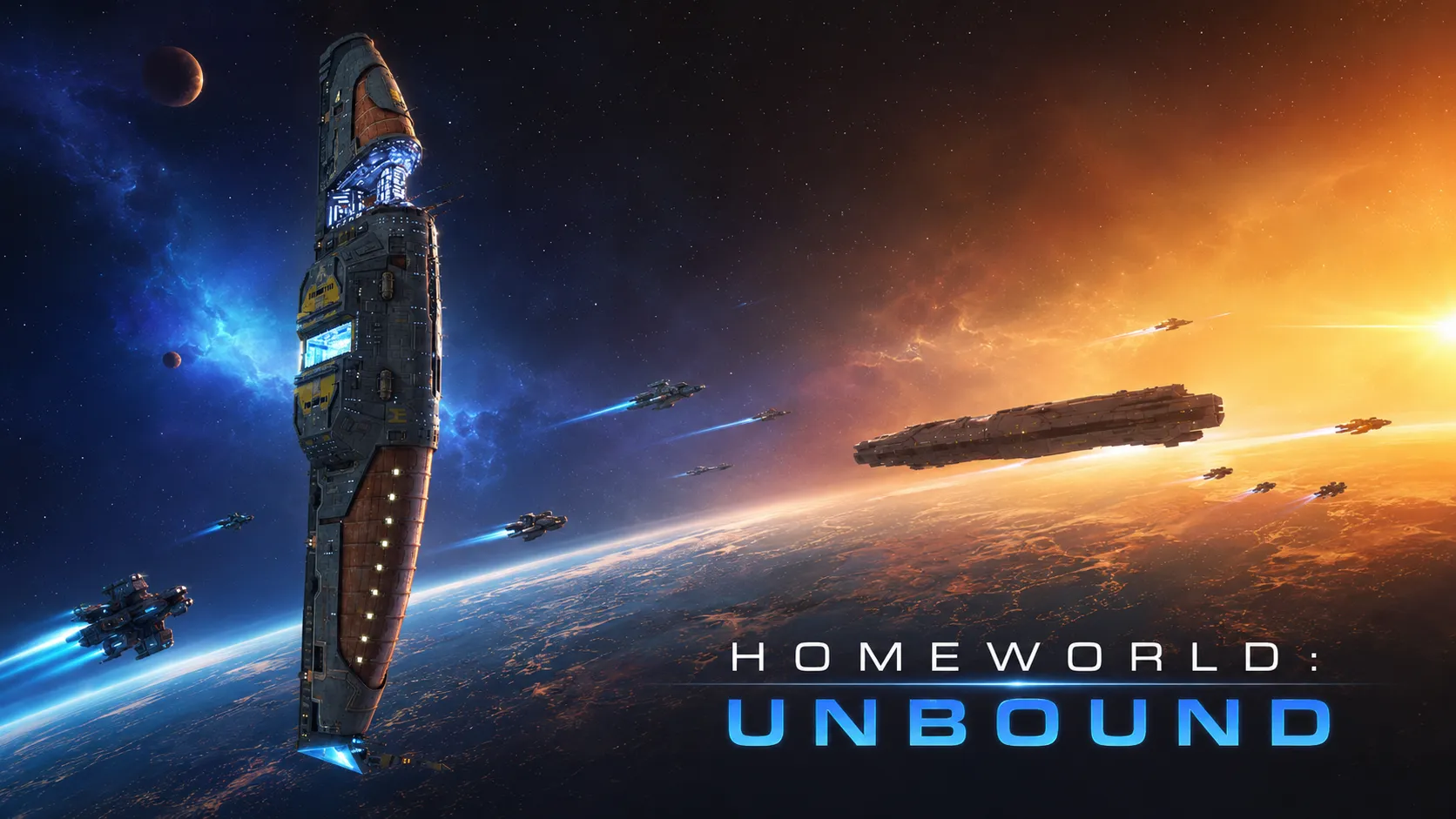
Homeworld (1999) in room-scale VR, running natively on a Meta Quest 3.
Not streamed from a PC, and not the flat game on a virtual monitor. The engine renders the battle in tracked stereo around you, and you command the fleet by pointing at it.
Homeworld’s own fiction was already describing this. You play Karan S’jet, a scientist who had herself surgically integrated into the Mothership’s core and who perceives the fleet through a neural link rather than through a screen. Every one of the game’s interface conventions is a compromise made for a mouse and a monitor. This port removes the compromise rather than adding a gimmick.
The name comes from the Bentusi, the trader race who gave up planets to live in the void — the Unbound. It cuts the other way too.
What VR actually changes
Orders are placed in real 3D, because a tracked controller has six degrees of freedom where a mouse has two. Routes are drawn freehand and flown as curves. Ships are their true relative size, with the monitor-era scaling that inflates distant fighters switched off. The two hands have distinct jobs — one commands, one points — and a command wheel at the left wrist carries the twenty-odd verbs that six buttons cannot. The strategic map is not a screen you open but a battlespace you stand in, with sensor coverage drawn as the spheres it always was, and orders can be given without leaving it.
Lineage
An unaffiliated fan project, built on the source Relic released in 2003 by way of Homeworld SDL and Gardens of Kadesh. No game assets from any commercial release are distributed. Homeworld is a trademark of its respective owners.
20 learnings from this project →
Updates
Homeworld: Unbound 0.14 — your fleet answers you again
Move orders came back silent — no chime, no pilot on the radio, nothing for a hotkey group. The VR controls speak to the engine directly rather than faking key presses, which is deliberate, and the acknowledgements the keyboard path picked up along the way went missing with it. In a headset, where the destination is often behind you, that callback was frequently the only sign an order had been taken.
Homeworld: Unbound 0.13 — the engine could never start twice
Quit the game, launch it again, and it sat in the loading environment and never started — a third press worked, and that had been true of every release so far. It turned out to be underneath the crash the last build fixed: the engine cannot run a second time in a process Android has kept warm. Separately, the permission prompt was itself what hung a fresh install.
Homeworld: Unbound 0.12 — a crash that looked like a hang (corrected by 0.13)
Adding your own game files after playing the demo left the next launch sitting in the headset's loading environment forever. It looked like a hang and it was a crash — the app died before presenting a frame, and a compositor with no frame to show just keeps showing its own room. The account of why is right; the claim that this build ended the second launch was not.
Homeworld: Unbound 0.11 — the map stopped being a screen
The Sensors Manager was the one Homeworld screen that was never really a screen — a 3D scene with its own camera, drawn flat on the wrist panel until now. It opens into the room instead, with sensor coverage drawn as the spheres the manual always described. Also: pressing and dragging on the panel never moved the pointer, in any build so far.
Homeworld: Unbound is on SideQuest
The listing has come through approval and is public. It went up carrying 0.10 — this morning's release — rather than the older build that had been sitting in review since it was submitted.
Homeworld: Unbound 0.10 — the full campaign without a PC
Playing the full game has always meant plugging the headset into a computer, because the only folder the game could read from is the one Android 11 closed to every file manager on the device. It now reads your Homeworld data out of Downloads, where you can actually put it — in place, without copying or renaming anything.
Homeworld: Unbound 0.9 — the smoothing comes off, and a save error that blamed your disk
Homeworld's ship textures are 32x32 and 64x64, drawn to be read on a 1999 monitor. A headset magnifies them far past that, and smoothing them recovered no detail while smearing what was already there — so it is off by default now. Separately, saving a new game failed for anyone who had ever copied a saves folder onto the headset by hand.
Homeworld: Unbound 0.8 — only the host sets up a port
Homeworld sends every player's orders to every other player directly, which is fine on a home network and unworkable across the internet. Anything a player cannot be reached at is now passed on by the host, so nobody but the host configures anything.
Homeworld: Unbound 0.7 — a name of its own, and a version number that moves
Internet play finally lands here rather than in 0.6. The app also stopped borrowing its identity from the project it was forked from — which matters more than it sounds, because Android and every sideloader were both reading that identity literally.
Homeworld: Unbound 0.6 — three addresses a LAN makes equal (superseded by 0.7)
Three networking bugs, none of which could have shown up on a LAN, because a LAN makes equal the one distinction all three got wrong. The diagnosis holds up; the claim that it was fixed did not.
Homeworld: Unbound 0.4 — one APK, and a crash worth writing down
Two APKs became one that plays either campaign, B became the attack button, drawn routes are flown as curves — and hyperspacing out of a mission stopped crashing the game.
Homeworld: Unbound 0.3 — handling fixes
A round of fixes that only show up once you actually play: focusing put you inside the hull, the Mothership stole every click near it, and drawn routes bulged past where your hand went.
Homeworld: Unbound 0.2 — the lighting fix
A player said the ships looked lit from all sides where the original lit them from one distant source. They were right, and the cause was the colour space, not the shading.
Homeworld: Unbound 0.1 — it runs on the headset
First release. Homeworld 1999 rendering in tracked stereo on a Quest 3, natively, with orders given by pointing at the fleet rather than through a virtual monitor.